Overview
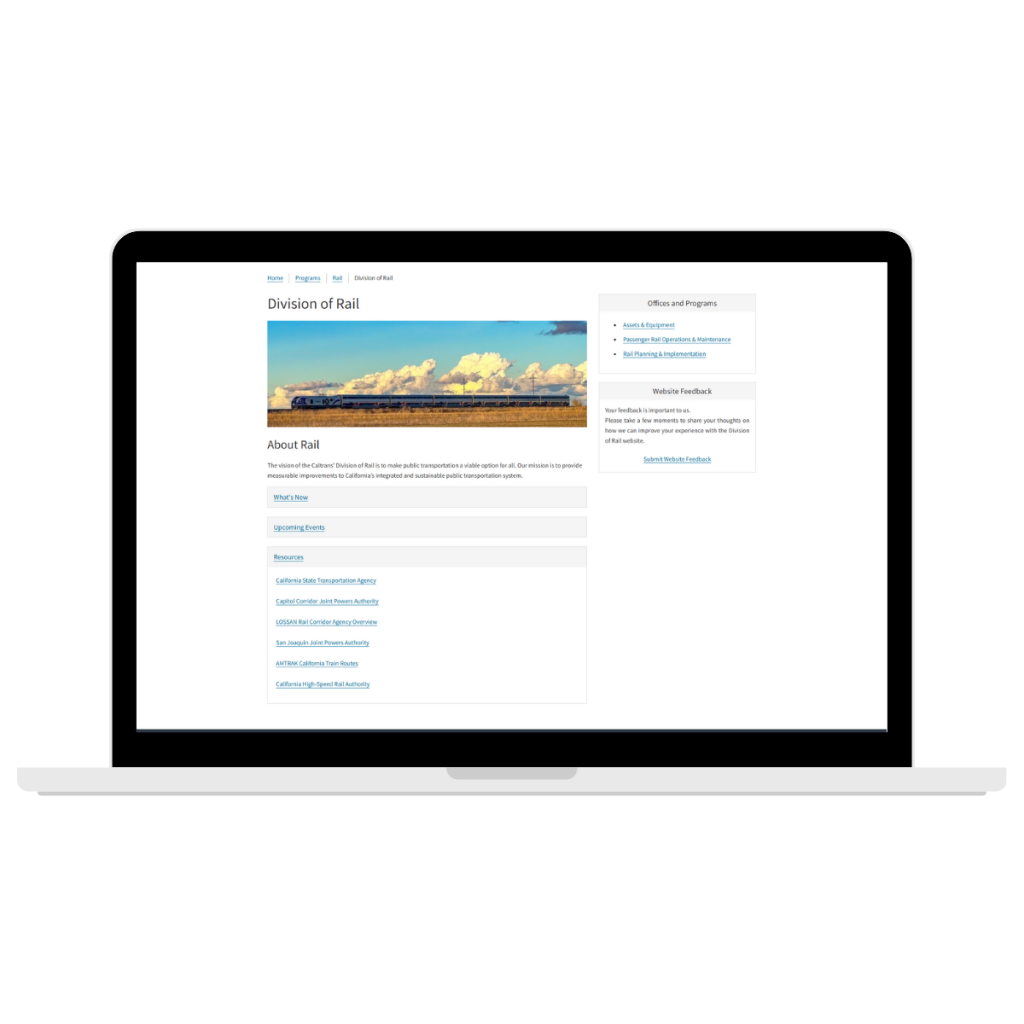
The Division of Rail, a fairly new division at Caltrans, had a growing ecosystem of content that needed to remain usable, accessible, consistent and maintainable. Plus, the old content needed a refresh.
Role
Project Lead / Web and Digital Compliance Analyst, Division of Planning and Modal Programs
- Led day-to-day project delivery across multiple teams, aligning stakeholders, content and technical work towards shared deadlines
Rather than aesthetics, and in addition to the content and structure, one of the themes for this project was communication. Not just ensuring that the public-facing communication was accurate and complete before publishing, but also collaborating with the stakeholders to ensure everything would be alright.
I started by reviewing what was already there, auditing pages and folders. Most of everything was scattered blocks of text, and content was missing. For example, some pages had contact information other offices had paragraphs upon paragraphs to explain what their office did and others barely had a sentence. Needless to say, not everyone was on the same page. So, I managed the project day-to-day, which really meant wrangling up the content from different people and sending various follow-up emails and scheduling meetings. Also documenting every phase and minutiae in the project tracker, which I actually really enjoyed. This was actually really helpful in getting a birds-eye perspective of the type of content we had on hand, a sense of the Division’s vibe and what kind of content we needed from them.
After getting the content (and while we waited for the content to arrive) I got to work in Sitecore. Reminiscent of Brad Frost’s Atomic Design, I created reusable Sitecore components (or molecules) such as sidebar containers for the contacts, html snippets to make the spacing less awkward, and interactive components like the accordion sets so that overall the content would be easy to digest for the public. Altogether, these created a template I could reuse for other offices for the Division of Rail without needing to rebuild them one by one. This was one template inside the overarching Caltrans (CA State Template) systems.
Approach
Things can look fine or “look good” and then still fail accessibility requirements, or be neglected by only adding paragraphs and not differentiating sections or headings. Sometimes “good enough” isn’t good at all.
The “Before” version of these pages where good enough (at first glance side eye) because they were built under the California State Template so they sort of matched the rest of the pages in the website. So the text was part of the already-built system, the colors where correct because they came from the [limited] palette. However, a screen reader user wouldn’t be able to consume the content properly if it’s just unorganized blocks of text. A screen reader user requires arranged html components, and honestly this makes a good foundation for the content. Not only that, but there where typos scattered throughout, old email addresses and names of people that had moved on from their positions needed to be updated too.
I for sure wanted (and want) things to be pixel-perfect – and the office chiefs for sure just wanted to keep it moving – so this project was all about balancing priorities: clear communication with the public and stakeholders, thoughtful decision-making, and attention to details that shaped the final experience.
Outcome
-
Established a more scalable content system by creating reusable Sitecore components and page patterns, while refreshing the existing content
-
Raised the baseline for usability and accessibility for the division by applying consistent standards throughout the work
-
Improved the experience for both users and stakeholders, with positive feedback on the resulting pages
This project reflects my work as an accessibility and content systems owner within a large state agency. I balanced organizational standards (both at a smaller department rules and state-wide criteria), stakeholder needs, user experience, and simply the practical realities of maintaining content at scale. In an earlier role at Caltrans, I built accessible, interactive forms with JavaScript logic. That work established my foundation in accessibility and taught me to think about accessibility as part of how a system is built, not something just added at the end. I now carry that approach into every project.
Skill Stack
- Section 508
- WCAG
- Content governance
- Web standards
- Accessible PDF
- HTML / CSS / Javascript
- Sitecore / Drupal